Den Bosch
Master of Arts in Fine Arts & Design

Ecology Futures

EF

Ecology Futures is a pathway that approaches the multiple ecological crisis as a political, relational, and material condition inseparable from histories, extractivism, and normative modes of knowledge production.


Program Overview

  • Master of Arts in Fine Art & Design Pathway: Ecology Futures
  • Duration: 24 months (4 semesters)
  • Mode: Full-time
  • Language: English
  • Location: Den Bosch, the Netherlands
  • Credits: 120 ECTS
  • Degree: Master of Fine Art and Design
  • Institution: Avans University of Applied Sciences
  • Accreditation: Fully accredited by NVAO


Program

The Master track Ecology Futures offers a practice-led research masters programme where you will:

  • Work with living materials
  • Think and work ecologically
  • Immerse yourself within vibrant ecologies
  • Learn how to create with the beings of the world
  • Develop new futures

Grounded in bio-based art and design, the program understands ecology as an entangled field of human and more-than-human relations, where matter, meaning, power, and subjectivity are co-constituted. Emphasizing plurality, contradiction, and collective study, the program resists singular narratives of progress and sustainability, instead cultivating transversal forms of learning that support multiple, coexisting ecological futures.  

Students work with living materials in laboratory environments, engage critically with theoretical frameworks that challenge anthropocentrism and normative ontologies, and conduct situated fieldwork beyond the classroom, employing both analog and digital tools. Central to the program is the Design for Inter Species Collectives Laboratory (DISCO LAB) at the Centre of Applied Research for Art, Design, and Technology (CARADT), which supports hands-on experimentation as a form of artistic research. Graduates develop the capacity to intervene critically and creatively in ecological and societal struggles through politically engaged, practice-based, and transdisciplinary approaches.

Ecology Futures is for students who want to think across disciplines, work collaboratively, and position art and design as forms of inquiry, resistance, and world-making. Graduates leave the program equipped to navigate complexity, work with uncertainty, and intervene creatively in ecological, cultural, and societal challenges.

Year 1

The first year is thought of as foundational and invites each participant to experiment, explore new possibilities within their own practice and take advantage of the different elective modules offered to them. Informed by research seminars, interdisciplinary modules, and field trips, you will be challenged to redefine your art practice within a collaborative, peer-to-peer environment.


A core component of the first year is the Rethinking the Artist Economy Residency. In this program, all Master in Fine Art and Design students explore how to make their practice both socially engaged and ecologically grounded. By providing the tools to move beyond extractive systems, we help you transition toward ways of working rooted in care, reciprocity, and connection. Ultimately, the residency supports you in building a sustainable livelihood based on what you value and find meaningful.

Year 2

The second year is focused on thesis writing and a final graduation project. This year, the participant can delve in a specific project connecting research and practice.


The third semester features a group exhibition at an external location, and the fourth semester culminates in the graduation show. Here, you will present your graduating work and research to a relevant professional network.


Furthermore, professional practice modules prepare you to enter the professional field and establish your career after completing the Master’s program. You will be trained in writing funding applications, developing a professional portfolio, and building a comprehensive CV.
Lieke Mangindaan

‘Ocean Amnesia’
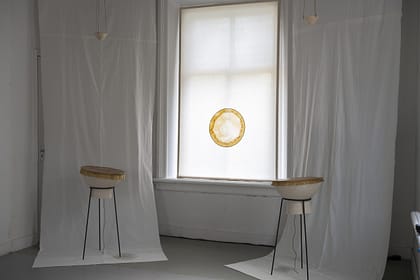
The (ongoing) research arose questions about how oceanic or fluid thinking can replace rigid ways of thinking. Water washes away. Asking us what to remember, and what to let go – unlearn, undo, unbuilt. Water is fluid as both matter and meaning.

Alumni Ecology Futures, 2025

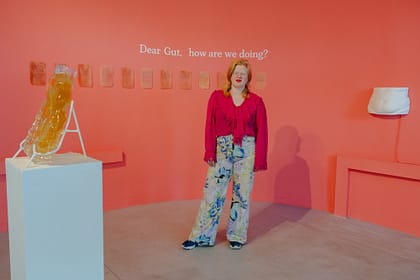
Karenina van den Crommenacker

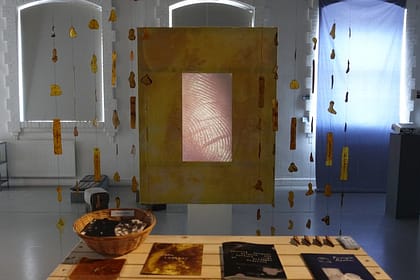
In this project, I embark on a journey to reconnect with my body, particularly with my gut—which I approach as an assemblage of human and microbe. Our human existence is intricately interwoven with microbial life, a relationship crucial to survival. The diversity and vitality of our microbiome intricately shape our physical and mental well-being. Consequently, connecting with our microbiome is the key to reconnecting with our bodies

Alumni Ecology Futures, 2024

Jurrel Baker

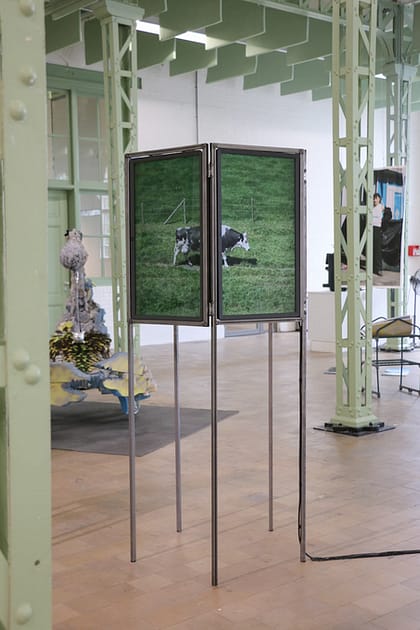
“The milking carousel takes you around the topic of ammonia pollution.”


Alumni Ecology Futures, 2023

Kristina Suryani

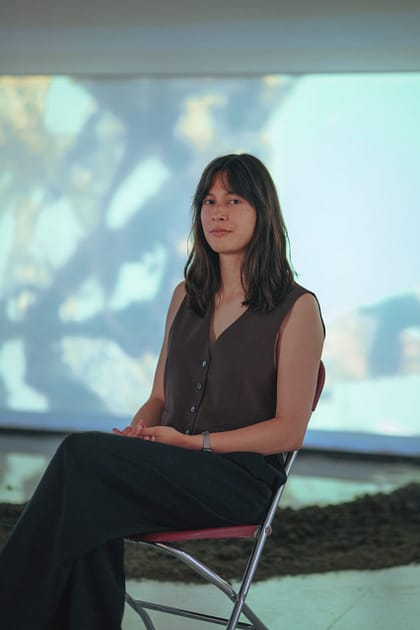
I came into these studies wanting change, as I was stuck in a mindset that kept me from moving forward as an artist and designer. This Master’s program allowed me to learn, work, and create with nature, understanding our interconnectedness beyond what we can see. From creating biomaterials in the lab to on-site classes and workshops, and an international community, I’ve grown into an artist who is aware, evolving, and committed to change for a better future.

Alumni Ecology Futures, 2025

Lieke Mangindaan

‘Ocean Amnesia’
The (ongoing) research arose questions about how oceanic or fluid thinking can replace rigid ways of thinking. Water washes away. Asking us what to remember, and what to let go – unlearn, undo, unbuilt. Water is fluid as both matter and meaning.

Alumni Ecology Futures, 2025

Karenina van den Crommenacker

In this project, I embark on a journey to reconnect with my body, particularly with my gut—which I approach as an assemblage of human and microbe. Our human existence is intricately interwoven with microbial life, a relationship crucial to survival. The diversity and vitality of our microbiome intricately shape our physical and mental well-being. Consequently, connecting with our microbiome is the key to reconnecting with our bodies

Alumni Ecology Futures, 2024

Jurrel Baker

“The milking carousel takes you around the topic of ammonia pollution.”


Alumni Ecology Futures, 2023

Kristina Suryani

I came into these studies wanting change, as I was stuck in a mindset that kept me from moving forward as an artist and designer. This Master’s program allowed me to learn, work, and create with nature, understanding our interconnectedness beyond what we can see. From creating biomaterials in the lab to on-site classes and workshops, and an international community, I’ve grown into an artist who is aware, evolving, and committed to change for a better future.

Alumni Ecology Futures, 2025

Lieke Mangindaan

‘Ocean Amnesia’
The (ongoing) research arose questions about how oceanic or fluid thinking can replace rigid ways of thinking. Water washes away. Asking us what to remember, and what to let go – unlearn, undo, unbuilt. Water is fluid as both matter and meaning.

Alumni Ecology Futures, 2025

Karenina van den Crommenacker

In this project, I embark on a journey to reconnect with my body, particularly with my gut—which I approach as an assemblage of human and microbe. Our human existence is intricately interwoven with microbial life, a relationship crucial to survival. The diversity and vitality of our microbiome intricately shape our physical and mental well-being. Consequently, connecting with our microbiome is the key to reconnecting with our bodies

Alumni Ecology Futures, 2024

Jurrel Baker

“The milking carousel takes you around the topic of ammonia pollution.”


Alumni Ecology Futures, 2023

Kristina Suryani

I came into these studies wanting change, as I was stuck in a mindset that kept me from moving forward as an artist and designer. This Master’s program allowed me to learn, work, and create with nature, understanding our interconnectedness beyond what we can see. From creating biomaterials in the lab to on-site classes and workshops, and an international community, I’ve grown into an artist who is aware, evolving, and committed to change for a better future.

Alumni Ecology Futures, 2025

Lieke Mangindaan

‘Ocean Amnesia’
The (ongoing) research arose questions about how oceanic or fluid thinking can replace rigid ways of thinking. Water washes away. Asking us what to remember, and what to let go – unlearn, undo, unbuilt. Water is fluid as both matter and meaning.

Alumni Ecology Futures, 2025

Karenina van den Crommenacker

In this project, I embark on a journey to reconnect with my body, particularly with my gut—which I approach as an assemblage of human and microbe. Our human existence is intricately interwoven with microbial life, a relationship crucial to survival. The diversity and vitality of our microbiome intricately shape our physical and mental well-being. Consequently, connecting with our microbiome is the key to reconnecting with our bodies

Alumni Ecology Futures, 2024

Jurrel Baker

“The milking carousel takes you around the topic of ammonia pollution.”


Alumni Ecology Futures, 2023

Kristina Suryani

I came into these studies wanting change, as I was stuck in a mindset that kept me from moving forward as an artist and designer. This Master’s program allowed me to learn, work, and create with nature, understanding our interconnectedness beyond what we can see. From creating biomaterials in the lab to on-site classes and workshops, and an international community, I’ve grown into an artist who is aware, evolving, and committed to change for a better future.

Alumni Ecology Futures, 2025

Lieke Mangindaan

‘Ocean Amnesia’
The (ongoing) research arose questions about how oceanic or fluid thinking can replace rigid ways of thinking. Water washes away. Asking us what to remember, and what to let go – unlearn, undo, unbuilt. Water is fluid as both matter and meaning.

Alumni Ecology Futures, 2025

Karenina van den Crommenacker

In this project, I embark on a journey to reconnect with my body, particularly with my gut—which I approach as an assemblage of human and microbe. Our human existence is intricately interwoven with microbial life, a relationship crucial to survival. The diversity and vitality of our microbiome intricately shape our physical and mental well-being. Consequently, connecting with our microbiome is the key to reconnecting with our bodies

Alumni Ecology Futures, 2024

Jurrel Baker

“The milking carousel takes you around the topic of ammonia pollution.”


Alumni Ecology Futures, 2023

Kristina Suryani

I came into these studies wanting change, as I was stuck in a mindset that kept me from moving forward as an artist and designer. This Master’s program allowed me to learn, work, and create with nature, understanding our interconnectedness beyond what we can see. From creating biomaterials in the lab to on-site classes and workshops, and an international community, I’ve grown into an artist who is aware, evolving, and committed to change for a better future.

Alumni Ecology Futures, 2025

Lieke Mangindaan

‘Ocean Amnesia’
The (ongoing) research arose questions about how oceanic or fluid thinking can replace rigid ways of thinking. Water washes away. Asking us what to remember, and what to let go – unlearn, undo, unbuilt. Water is fluid as both matter and meaning.

Alumni Ecology Futures, 2025

Karenina van den Crommenacker

In this project, I embark on a journey to reconnect with my body, particularly with my gut—which I approach as an assemblage of human and microbe. Our human existence is intricately interwoven with microbial life, a relationship crucial to survival. The diversity and vitality of our microbiome intricately shape our physical and mental well-being. Consequently, connecting with our microbiome is the key to reconnecting with our bodies

Alumni Ecology Futures, 2024

Jurrel Baker

“The milking carousel takes you around the topic of ammonia pollution.”


Alumni Ecology Futures, 2023

Kristina Suryani

I came into these studies wanting change, as I was stuck in a mindset that kept me from moving forward as an artist and designer. This Master’s program allowed me to learn, work, and create with nature, understanding our interconnectedness beyond what we can see. From creating biomaterials in the lab to on-site classes and workshops, and an international community, I’ve grown into an artist who is aware, evolving, and committed to change for a better future.

Alumni Ecology Futures, 2025